As we explained in our article on the return of EET 2.0, electronic sales reporting will return to the Czech Republic on 1 January 2027. The legislation also introduces an income tax exemption for tips received by restaurant, café and bar employees, subject to a limit. Act No. 180/2026 Coll., Sections 30 and 36. To apply...
From 1 January 2027, electronic sales reporting — EET 2.0 (elektronická evidence tržeb) — will return to the Czech Republic. President Petr Pavel signed the legislation on 17 September 2026. Act No. 180/2026 Coll. was published on 7 October 2026. Who Must Report Sales The obligation applies to self-employed individuals (OSVČ) and legal entities, including...
From 2027, the Czech Republic is restoring the student tax credit (sleva na studenta), allowing eligible students to reduce their personal income tax by up to CZK 4,020 per year. President Petr Pavel signed the legislation on 17 September 2026. The changes form part of the legislative package introducing the new electronic sales registration system,...
Voluntary VAT registration in the Czech Republic can significantly reduce a company’s costs. In some cases, a business may not only reduce the VAT it has to pay, but actually receive a refund of input VAT into its bank account. One of the most favourable situations is when a business purchases goods or services subject...
Last updated: August 20, 2026 Value-added tax (DPH – Daň z přidané hodnoty in Czech) is one of the most important taxes in the taxing system. It is deducted from every item or a service merchandized in the country. This type of tax can be compared with a bearing wall during the construction of the...
Last updated: July 21, 2026 If you sell goods or digital services to customers in other EU countries — whether through your own website, a marketplace, a booking platform, or any other type of online channel — you may face complex VAT obligations. VAT on cross-border online sales is far from straightforward: different rates, different...
Last updated: July 21, 2026 In previous publications, we explained how VAT works for sales in the B2B and B2C formats. The next important element of the EU VAT system is the transfer of a company’s own goods between member states. This is an operation that often raises questions and, if accounted for incorrectly, can...
Last updated: July 21, 2026 In the previous article, we looked in detail at what happens with VAT when a Czech company sells goods to final consumers who are not VAT payers in the EU (the B2C segment, distance sales, the OSS scheme, and so on).Now we move on to the other half of the...
Article updated on July 2, 2026 This page provides an overview of the main current tax rates and mandatory payments in the Czech Republic for sole traders (OSVČ), entrepreneurs in the flat-rate tax regime (paušální režim), employers, and VAT payers (DPH). The data is current as of July 1, 2026. This information is for reference...
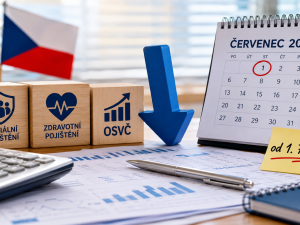
A significant change is being introduced in the Czech Republic for self-employed individuals (OSVČ). Minimum advance payments for social insurance will be reduced. This mainly affects those who carry out self-employment as their main activity and pay the minimum social insurance contributions, as well as entrepreneurs in the flat-rate tax regime (paušální daň) who fall...
After you file a tax return, the process does not always end immediately. The Czech Tax Office, or Finanční úřad, may accept the return without any questions, refund an overpayment, ask for clarification, require a correction, or start a more detailed review. The most important thing in this situation is to understand what exactly has...